info@naturaleyecare.com



 Home
Home


 Vision
 Vision


 Health
 Health
 Research/Services
 Pets
Pets About/Contact

Cataracts Information
Treatment Symptoms Types Causes Harmful drugs News Drs. reference
 Cataracts are the major cause of vision loss in the United States. Symptoms can include blurry,
hazy vision that worsens over time as well as sensitivity to glare. Research has shown that treatment in the form of
specific lifestyle, diet and supplement choices can support overall lens health.
Cataracts are the major cause of vision loss in the United States. Symptoms can include blurry,
hazy vision that worsens over time as well as sensitivity to glare. Research has shown that treatment in the form of
specific lifestyle, diet and supplement choices can support overall lens health.
A cataract appears as an opaque spot on the lens of the eye that obstructs vision. It may seem as though you are looking through a hazy cloud. The density of the cataract typically increases over time so the effect on your vision will vary depending the cataract density and the location of the cataract on the lens. Many people first experience a general blurriness of vision requiring more light to read by, and/or more difficulty reading street signs. Depth perception can often be affected resulting in an added risk of falling for seniors.
 Next: Nutritional support, diet, & lifestyle tips for the lens.
Damage
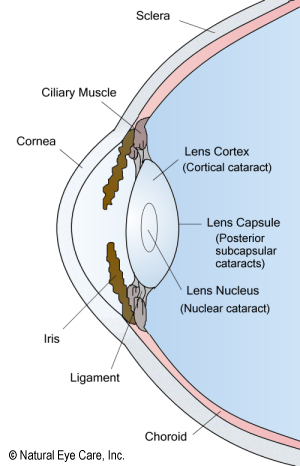
The lens can change as we age and be damaged in several ways. The most common is that with age it becomes less flexible and less able to adjust between near and far distances. The lens can become clouded, obscuring vision. Damage to the eye's lens impairs vision for driving, close work, color and depth perception. Many other eye conditions and specific medications can lead to lens damage. Patients with impaired lenses may experience blurry or cloudy vision, poor night vision, difficulty in depth and color perception and other symptoms.
Symptoms
- We seem to have hazy and/or blurry vision. This is especially true in bright light or glare conditions.
- We have poor vision at night, making driving dangerous at night.
- The eye lens may appear cloudy.
- We find that we need more light to read and that reading is tiring.
- Our depth perception is not very good.
- We see halos, especially in bright sunlight.
- Our glasses always seem dirty, no matter how much we clean them.
Types of Cataracts, Prevalence
Age of Onset
Cataracts are defined less by the age of onset than by the size and location. The age of onset does not determine the cause. Anyone with a genetic marker for cataracts could be more vulnerable to damage due to environmental toxins.7
Congenital or infantile cataract is visible within the first year of life. Congenital cataracts may be hereditary or secondary to a toxic event while in utero, such as rubella.
Juvenile cataract occurs within the first decade of life. It is also defined as occurring within the first 20 years. Cataracts associated with a systemic or genetic disease such as retinitis pigmentosa, for example, may not present until a person is in their 20s or 30s. Patients with retinitis pigmentosa often develop a type of cataract called a “subcapsular cataract.”
Pre-senile cataract occurs before age 45.
Senile or age-related cataract occurs after age 45. Age-related cataracts are generally attributed to multiple environmental insults accumulated over a number of years, including ongoing exposure to sunlight, oxidation in the lens, as well as poor circulation and delivery of essential nutrients to the eyes.
Cataracts in Adults
Cataracts tend to worsen over time and are the major cause of blindness. Almost 40 million people in the U.S. alone, suffer from cataracts. Only 10% of people are affected with cataracts by age 55, but the figure jumps to 50% by age 75, and 70% by age 80+.8 Cataract removal is the most common surgical procedure covered by Medicare with almost 3,000,000 surgeries performed per year.
Cataracts in Children
Approximately three of every 10,000 children develop cataracts; this is often due to abnormal lens development during the mother’s pregnancy. The child may be born with the cataract (congenital) or develop it during childhood. Congenital cataracts can range in degree of severity, resulting in different levels of impact on vision. This type of cataract is responsible for nearly 10% of all vision loss in children worldwide, and it is easily treatable through conventional medicine. However, if the cataract is small and/or off center, it may not have to be removed.
Genetics and Cataracts
Genetics may play a role in cataract development at any stage. According to researchers, there are two mutations in what is termed the heat shock transcription factor gene (HSF4) that have been reported to be associated with hereditary cataracts (HC) in several people. Hereditary cataracts are estimated to account for 8.3–25% of congenital cataracts, and they may be a part of a multisystem genetic disorder.9, 10, 11
Location of Onset
Nuclear cataracts are those found in the central part of the eye lens. Due to the location of the cataract, these tend to impact vision to a greater degree than those located elsewhere on the eye lens, even in early stages of development.
Cortical cataracts are found on the outside part of the eye lens and are commonly found in people with diabetes. Given the location of this type of cataract, these may have little effect on vision, particularly in the early stage of development, but they can develop quickly in diabetics.
Posterior subcapsular cataracts appear on the back part of the eye lens. Symptoms can include sensitivity to bright light, seeing of halos, and/or difficulty in distance vision.
Secondary cataracts are not technically cataracts; however, they are called this in mainstream medicine. Secondary cataracts occur when old cells of the original lens remain in the eye and collect on the new artificial lens. They may occur in up to 50% of post-cataract surgery patients, and they can result in symptoms similar to the original cataract condition. Doctors use a YAG laser treatment to “burn” off the excess cells from the new lens. This procedure is typically fast, painless, and very effective, and usually done in the eye doctor's office. Immunological and gene therapy approaches to prevent this complication are under development and appear promising.
Causes
Read about the mechanics of cataract formation.
- Antioxidant deficiencies: Researchers report that free radical damage to the proteins in the lens of the eye are important factors in development of cataracts.2, 3
- Nutrient deficiencies: Researchers report that nutrient deficiencies play a role in the development of cataracts.
- Deficient glutathione levels contribute to a weak system of antioxidants. Lipoic acid, vitamins E and C, and selenium support glutathione levels.2
- Patients with cataracts tend to be low in vitamin A, lutein and zeaxanthin.2
- Riboflavin, vitamin B2, plays an important role in protection against cataracts.2
- L-carnosine is naturally produced by the body and its deficiency may contribute to cataract development.3
- Free radicals: The by-products of our metabolism of food, cause oxidation, and in turn accelerating aging. As the lens of the eye ages, it hardens and loses the flexibility needed for focusing.
- Chronic physical stress: Due to injury to the back or neck, continuing dental pain, or stress that limits movement of the head (and eyes) and increases tension and tightness in muscles.
- Allergies and food sensitivities, especially allergies of soy, wheat or dairy products which might give rise to congestion and slow or block circulation of tiny capillaries delivering nutrients to the eye, as well as lymphatic drainage.
- Smoking: People who smoke have a much higher risk of developing cataracts. When you smoke you rob the body of vitamin C a needed nutrient for healthy vision. Smokers also have more cholesterol and fat in their blood system with more risk of coronary artery disease. This condition also compromises the effectiveness of tiny blood vessels in the eyes - reducing the ability of the different parts of the eye to receive adequate nutrition. Learn more about the relationship between smoking and cataracts.
- Diabetics form cataracts at a younger age than those who do not suffer from diabetes. This is due to the build-up of sugar resulting in glycation (binding together of sugar and protein molecules). Researchers note that argpyrimidine, a biochemical formed in the presence of sugars, increase in diseased lenses.6
- Poor digestion and nutrition: nutritional deficiencies contribute to earlier and faster-developing cataracts. People with incomplete digestion and ongoing bowel and elimination problems have a four times as many cases.
- Heredity and advanced age by themselves are risk factors.
- Heredity and congenital cataracts. In about 4/10ths of infant births cataracts are present at birth or develop soon after. Some can be removed surgically; future treatments may include stem cell therapy.
- Sunlight includes invisible UV light that accelerates damage to the lens by free radicals. These effects are cumulative. Researchers have pointed out that no amount of sunlight is a safe level for the eyes. They calculate that there is a 10% increase for every year of exposure of "Maryland sun-years" (the amount of sun falling on Maryland in one year), and the eye takes in 9 to 18% of this exposure to UV radiation.4
- Alcohol: More than one drink a day doubles the risk.
- High BMI: The World Health organization reports that high body mass index is an indicator of high cataract risk.
- Inactivity: Researchers report that inactivity with little exercise increases the risk of cataract.5
- Surgery complication: Cataracts can also develop following eye surgery such as a vitrectomy for epiretinal membrane.
 Toxins and drug side effects, including steroids and photosensitizers that are found in medicines
prescribed for gout and high
cholesterol as well as and antibiotics. Drugs which make you more light-sensitive to sunlight cause chemical changes to tissue which, in turn,
can make you more vulnerable. Among the more common
photosensitizing drugs:
Toxins and drug side effects, including steroids and photosensitizers that are found in medicines
prescribed for gout and high
cholesterol as well as and antibiotics. Drugs which make you more light-sensitive to sunlight cause chemical changes to tissue which, in turn,
can make you more vulnerable. Among the more common
photosensitizing drugs:
- Birth control pills
- Antihistamines
- Sulfa drugs
- Tranquilizers and antidepressants
- Oral anti-diabetic drugs
- Glucocorticoids (Prednisone) Cataracts will form in half of the people who take doses of 10-15 milligrams prednisone daily over 1-2 years.
- NSAIDS (for example ibuprofen, advil, meclofen).
- Steroids Cataracts caused by steroids are dense and can cause rapid vision loss. They will not go away when medication is stopped and have to be removed surgically. If you must take steroids, be sure to get plenty of antioxidants such as lutein, alpha lipoic acid, vitamin E, and vitamin C for prevention.
- Etretinate, isotretinoin
Related Conditions
- Cataracts can be related to other conditions because they increase the risk of other conditions.
- Cataracts can also be related to others because the other conditions make the risk of cataracts greater. (e.g. eye surgery)
- Cushing's syndrome - high cortisol blood levels, often due to continued use of corticoids, can cause steroid-induced cataracts
- Diabetes
- Floaters
- Retinal detachment
Cataract News
Want to learn more? See our blog for news on cataracts.
See Vitamins & Supplements to support the lens of the eye and overall eye health.
Footnotes
1. Diet, vegetarianism, and cataract risk., Paul N Appleby, Naomi E Allen, and Timothy J Key, The
American Journal of Clinical Nutrition, March 2011.
2. Head, K.A., Natural therapies for ocular disorders, part two: cataracts and glaucoma, Alternative Medicine Review - a Journal of Clinical Therapeutics, April, 2001.
3. J.C. Wohlhagen, OD, et al, Antioxidant eye drops provide another option for cataract patients, Healio, October, 2015
4. H. R. Taylor, Sheila West, et al, Effect of ultraviolet radiation on cataract formation, New England Journal of Medicine, December, 1988
5. J. Z. Selin, N. Orsini, et al, Long-term physical activity and risk of age-related cataract: a population-based prospective study of male and female cohorts, Ophthalmology, February, 2015.
6. B. Myunampati, S. Ghosh, et al, Evaluation of antioxidants and argpyrimidine in normal and cataractous lenses in north Indian population, International Journal of Ophthalmology, July, 2017.
7. Shiels, A., Hejtmancik, J.F. (2007). Genetic Origins of Cataract. Arch Opthalmol, 125(2), 165–173.
8. National Eye Institute. Cataracts. Retrieved Jan 7, 2018 from https://nei.nih.gov/eyedata/cataract.
9. Francois, J. (1982). Genetics of cataract. Ophthalmologica. 18461–71.
10. Merin, S. (1991). Inherited cataracts. In Merin S. editor. Inherited Eye Diseases (pp. 86–120). New York: Marcel Dekker.
11. Ibid. Shiels. (2007).
Also see research on cataract vitamins; some nutrients are more effective for some types
of cataract.