info@naturaleyecare.com



 Home
Home


 Vision
 Vision


 Health
 Health
 Research/Services
 Pets
Pets About/Contact

Diabetic Retinopathy
Vitamins/supplements Treatment Symptoms Causes News FAQ
Diabetic retinopathy is a potentially blinding complication of diabetes that damages the eye's retina. It effects half of all Americans diagnosed with diabetes.
However, only 6% of diabetics lose their vision. Blindness is largely preventable if patient and the medical team work together diligently. Prevention relies upon the proper use of medications, daily blood sugar testing, correct lifestyle habits, diet and supplementation.
Complications related to sugar/glucose imbalances in the blood can result in damage to the retina which may not be noticeable at first, but the consequences can get worse with time severely threatening vision.
 Next: Nutrition,
vitamins, diet, & lifestyle for diabetic retinopathy.
Next: Nutrition,
vitamins, diet, & lifestyle for diabetic retinopathy.
Symptoms
It is possible to have diabetic retinopathy for a long time before you realize it because the symptoms can be difficult to detect. In many cases, the symptoms of diabetic retinopathy are not apparent until the retina has been quite damaged and your sight has been compromised.
Symptoms of diabetic retinopathy and its complications may include:
- Blurry or distorted vision caused by high glucose levels
- Difficulty reading and other close work
- Increased number of eye floaters
- Partial, fluctuating or total vision loss or what feels like a permanent shadow cast across your field of vision
- Impaired color vision
- Eye pain
- Reactive hypoglycemia (low blood sugar, or insulin resistance), which is a symptom of pre-diabetes. It occurs in people who regularly consume sugars and refined carbohydrates such as refined foods, sweetened beverages, bread, pasta, rice, and white potatoes.
Causes of Diabetic Retinopathy
- The blood/ocular barrier layer of the retina is a compound structure in the eye that prevents large particles in large capillaries from entering the retina. The retinal pigmented layer is responsible for the outer layer of this barrier and diabetic retinopathy incidence is related to its breakdown. 11
- Photoreceptor cell death/damage may play a central role in deterioration of microcapillaries in the eye that leads to diabetic retinopathy. Their deterioration is another hallmark of development of the condition.12 Researchers now report that oxidative stress spreads from damaged photoreceptor cells.13
- Diabetes & Pre-diabetes
- (formerly called juvenile-onset or insulin-dependent diabetes) is a condition where the body's immune system destroys the cells that release insulin, eventually eliminating insulin production from the body. It is a very serious, potentially life-threatening condition. Without insulin the body’s cells cannot absorb glucose to produce the energy that we need to live. Type 1 diabetes generally begins in childhood; however, it does affect adults, and at increasing rates today. For some time, only a small portion of diabetes sufferers were diagnosed with type 1 diabetes (5–10%). But for over a decade, reports have been showing that type 1 diagnoses are rising by 3% annually in the U.S., and particularly in children between the ages of 5 and 9.
- (formerly called adult-onset diabetes or non-insulin-dependent diabetes) is the more prevalent type of diabetes, comprising 90-95% of the cases. It typically develops over many years, and it is characterized by the body’s inability to use insulin in the correct way; this is called insulin resistance. As type 2 diabetes worsens, the pancreas may make less and less insulin (insulin deficiency). Type 2 diabetes is typically diagnosed during adulthood; however, the incidence of type 2 diabetes in children is rising dramatically.
- There is another type of diabetes called “gestational diabetes” which occurs only during a woman’s pregnancy. Researchers don't know why some women develop gestational diabetes, but it may have to do with the placenta producing insulin-blocking hormones, impairing the action of insulin in the mother’s cells, resulting in raising her blood sugar. Gestational diabetes mellitus (GDM), although a temporary condition during pregnancy, increases the life-long risk of developing type 2 diabetes in both mother and baby. The risk does not go away. Every year, approximately 7% of all pregnant women are affected by GDM, and of those, 5–10% of these women go on to have type 2 diabetes. In fact, women who have had GDM have a 20–50% chance of becoming diabetic sometime in their life.
- Low insulin sensitivity: enough insulin is present, but the physiology doesn't respond adequately.
- Nearly 8% of pre-diabetics have diabetic retinopathy. Pre-diabetics are defined as blood glucose levels are higher than normal but not high enough for a diagnosis of diabetes. It's also known as "impaired fasting glucose" or impaired glucose tolerance.10
- In one study more than 19% of patients with adult onset diabetes had diabetic retinopathy.10
- Poor diet high in refined carbohydrates and sugar, low in whole foods and antioxidants
- Lack of regular exercise
- Low serum magnesium in diabetic patients is a risk factor for diabetic retinopathy. 5
- Low folic acid levels are tied to greater risk of diabetic retinopathy.1
- Patients with kidney disease are at a greater risk of developing diabetic eye disease.2
- Vitamin D deficiency is associated with diabetic eye disease, like folic acid deficiency, the greater the deficiency the greater the risk and severity.3
- Lab animals treated with an extract of a tropical plant, Caesalpinia pulcherrima displayed better antioxidant levels and lessening of levels of blood sugar alcohol.4
- Depression has been tied to an increased risk of developing diabetes.6
- Inflammation has been associated with an increased risk of developing diabetes; furthermore, insulin treatment does not alleviate inflammation, as well as the integrity of capillaries and nerve functioning in the retina.7, 8
- Lack of oxygen to the retina has been reported as a cause of diabetic macular edema. In a small pilot study while patients were given supplemental oxygen therapy the condition improved. When such supplemental oxygen ceased the condition continued to worsen.9
Stages of Diabetic Retinopathy
NIH defines four stages of diabetic retinopathy:
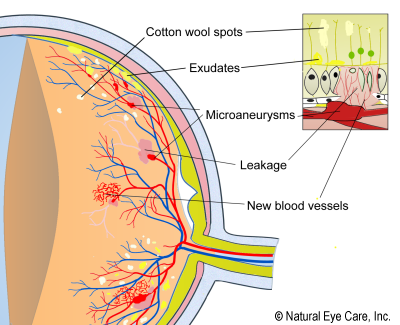
- Mild nonproliferative form in which tiny capillaries experience swelling and leaking. These are called "microaneurysms."
- Moderate nonproliferative form in which some of these capillaries are completely occluded depriving the retina of nourishment.
- Severe nonproliferative form in which many capillaries are blocked and more of the retina does not receive needed nutrients. This triggers
the body to grow new blood vessels to supply the deficit. These new blood vessels are weak, and tend to leak blood and fluids that can cause severe vision loss if not treated.
In addition, “cotton wool” spots may appear on the retina, evidence of nerve fiber damage. These are a hallmark of pre- or non-proliferative diabetic retinopathy. These look like fluffy white spots that develop as a result of diabetic retinopathy or hypertension. In addition to cotton wool spots are hard exudates which are similar to the drusen seen in macular degeneration. - Proliferative form is an advanced stage of diabetic retinopathy. New, fragile capillaries grow both within and along the surface of the retina and into the vitreous of the eye. The additional growth may not cause vision loss by itself, although portions of the retina can be distorted, in turn distorting vision. Because the new capillaries are thin-walled and fragile, they are at great risk of leaking.
- Ketosis may also develop if insulin production is insufficient. Ketosis occurs when the body starts burning fat instead of carbohydrates for energy. It arises from profound reduction in beta-cell mass (the cells that produce insulin) and results in ketone formation. Ketosis can become dangerous when ketones accumulate to too-high levels, leading to dehydration and changes to the chemical balance of your blood.
Diabetic Retinopathy News
Want to learn more? See our blog news on diabetic retinopathy.
See Vitamins & Supplements
to support circulation and the retina.
Research and information
See these studies on diabetic retinopathy treatment.
Footnotes
1. G. Malaguarnera, et al, Folate status in type 2 diabetic patients with and without retinopathy, Clinical Ophthalmology, August, 2015.
2. H.P. Hammes, et al, Risk Factors for Retinopathy and DME in Type 2 Diabetes-Results from the German/Austrian DPV Database, PLoS One, July 2015
3. N. Alcubierre, et al, Vitamin D Deficiency Is Associated with the Presence and Severity of Diabetic Retinopathy in Type 2 Diabetes Mellitus, Journal of Diabetes Research, May, 2015.
4. M.P. Kumar, et al, The inhibitory effect of Isoflavones isolated from Caesalpinia pulcherrima on aldose reductase in STZ induced diabetic rats, Chemico-Biological Interactions, July, 2015
5. Studies on Magnesium and Diabetic Retinopathy
6. W. Kanton, MD, Medical News Today, July 29, 2011
7. PCON Supersite, March, 2010
8. G. Bixler, Chronic insulin treatment of diabetes does not fully normalize alterations in the retinal transcriptome, MBC Medical Genomics, May, 2011.
9. Q. D. Nquyen, et al, Supplemental oxygen improves diabetic macular edema: a pilot study, Investigative Ophthalmology & Visual Science, February, 2004
10. H. X. Zhang, et al, Prevalence of and risk factors associated with diabetic retinopathy in pre-diabetic and diabetic population in Shanghai community, Zhonghua Yi Xue Za Zhi. July, 2009.
11. J. Cunha-Vaz, R. Bernardes, et al, Blood-Retinal Barrier, European Journal of Ophthalmology, 2011
12. T.S. Kern, B.A. Berkowitz, Photoreceptors in Diabetic Retinopathy, Journal of Diabetes Investigation, July, 2015.
13. Y. Du, A. Veenstra, et al, Photoreceptor cells are major contributors to diabetes-induced oxidative stress and local inflammation in the retina, Proceedings of
National Academy of Sciences (PNAS), August, 2013.
14. NIH. (2006). History of Gestational Diabetes Raises Lifelong Diabetes Risk in Mother and Child. Retrieved Nov 2 2017 from https://www.nih.gov/news-events/news-releases/history-gestational-diabetes-raises-lifelong-diabetes-risk-mother-child.