info@naturaleyecare.com



 Home
Home


 Vision
 Vision


 Health
 Health
 Research/Services
 Pets
Pets About/Contact

Wet AMD - Choroidal Neovascularization
Vitamins/supplements Retina Symptoms Causes
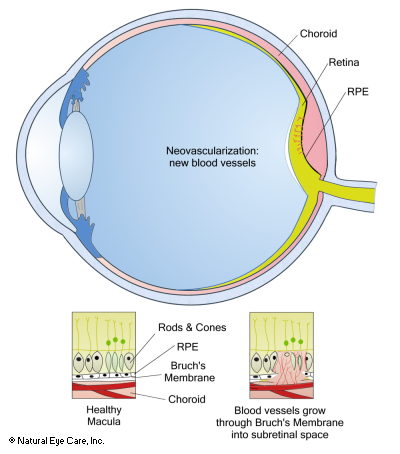
Choroidal neovascularization occurs when new blood vessels grow in the choroid layer of the retina, through the Bruch membrane and into the subretinal space (the space between the retina and the choroid) - crowding out proper functioning and sometimes resulting in blindness. The advanced or wet form of macular degeneration is an example of choroidal neovascularization.
 Next: Nutritional support, diet, & lifestyle tips for choroidal neovascularization.
Parts of the Retina
The retina consists of four major layers:
- Outer neural layer which contains nerve cells and blood vessels;
- Photoreceptor layer which is a single layer containing the light sensing rods and cones;
- Pigmented retinal epithelium (RPE), with the bruch's membrane separating the RPE from the
- Choroid layer, consisting of connective tissue and very fine capillaries known as choriocapillaries. They are responsible for carrying nutrients and oxygen to the cellular layers above them.
The choroid layer contains most of the eyeball's blood vessels. It is also the layer prone to bacterial and secondary infections. There is no current effective medical treatment and so the abnormal blood vessel growth can readily develop as sight impairment or total vision loss.
In the case of wet AMD patients, the fluid and blood along with the formation of new blood vessels form scar tissues which are trying to repair damages but are ultimately the cause of vision loss and possibly blindness.
Symptoms
Symptoms may include: seeing flickering or blinking lights in the affected eye or eyes, blurred vision, loss of vision. Symptoms may occur fairly suddenly, (a few weeks). They can also include variations in color perception, and wavy lines (noticeable in the amsler grid test).
Causes
The actual cause of choroidal neovascularization can vary.
- Macular Degeneration - the Wisconsin Beaver Dam Study funded by NIH showed that 1.2% of adults aged 43-86 with ARMD developed choroidal neovascularization.
- Myopia - the Beaver Dam study also demonstrated that choroidal neovascularization was caused by myopia in 5-10% of myopes.
- Ocular trauma is another likely cause of CNV. More than 50 vision conditions have been tied to the choroidal neovascularization formations. The known causes are related to degeneration, infections, choroidal tumors and/or trauma.
- Patients who wear soft contact lens who develop CNV may have experienced lack of oxygen to the eyeball due to a too-close fitting lens.
- New research suggests that the imbalances in intestinal microbiota, the friendly bacteria in your digestive system, may be a contributing factor in causing macular degeneration to progress to wet form. This is especially true for men who are obese.1
Related conditions
- Macular degeneration (dry form)
- Pseudoxanthoma elasticum is a rare genetic disease which affects the skin first and then can affect the eyes when it causes dimples in the Bruch membrane that separates the choroid layer from the pigmented layer of the retina.
- In optic disc drusen neovascularization may occur.
- Stargardt's is a form of genetically-based macular degeneration that arises in young people.
- Myopic macular degeneration is a form of severe degenerative myopia.
Wet macular degeneration news
Want to learn more? See our blog news on wet macular degeneration.
See Vitamins & supplements
to support the retina and overall eye health.
Footnotes
1. E.M. Andriessen, A.M. Wilson, et al, Gut microbiota influences pathological angiogenesis in obesity-driven choroidal neovascularization, EMBO Molecular Medicine, December, 2016.