info@naturaleyecare.com



 Home
Home


 Vision
 Vision


 Health
 Health
 Research/Services
 Pets
Pets About/Contact

Poor Night Vision
Vitamins/supplements Symptoms Causes News
Poor night vision disorders (night blindness, impaired dark adaptation, etc.) include the experience of reduced vision in dimly lit environments, including at night. They include partial or complete impairment in ability of the eyes to adapt from brightness to darkness. It is not a disease in itself, but rather a symptom of an underlying problem, usually located in the retina. It is common for patients who are myopic (nearsighted) to have some difficulties with night vision, but this is due to optical issues rather than to a retinal condition.
Poor night vision affects more people in other areas of the world than the U.S. because of wide-ranging vitamin A deficiencies in undeveloped nations. In America, it is a rare disease that affects less than 200,000 people.
 Next:
Nutritional support,
diet, & lifestyle tips for night vision.
Next:
Nutritional support,
diet, & lifestyle tips for night vision.
People with poor night vision typically are not able to see well in the dark. They are, however, able to see perfectly well during the day, even though transitions from bright environments to dim ones, such as when entering a darkened hall from the sunny outdoors, may be challenging.
One key to seeing at night is a healthy amount of rhodopsin, which is an eye pigment in the retina responsible for night vision. It is used specifically by the photoreceptor cone cells to perceive light, while the rods, on the other hand, are highly sensitive to darkness. Rhodopsin enables us to quickly adapt our vision from a dark room to a light room. Vitamin A is an essential component of rhodopsin, so a deficiency in vitamin A can result in poor night vision. Though vitamin A deficiency is rare in industrial nations, there are other reasons vitamin A intake may be compromised, including:
- Iron deficiency can affect vitamin A uptake.
- Small-bowel bypass surgery may reduce vitamin A absorption.
- Excess alcohol consumption impairs absorption.
- Medications can affect fat absorption (Xenical) or cholesterol (statins).
- Low fat diets may be low in vitamin A.
- Zinc deficiency is associated with decreased release of vitamin A from the liver.
- Other conditions such as fibrosis, pancreatic insufficiency, and inflammatory bowel disease affect how vitamin A is utilized in the body.
Symptoms
For people whose night vision begins worsening due to other related eye conditions, the vision loss can occur very slowly over time. It can also occur quickly, depending on how acute the eye condition is, such as with untreated retinal bleeding. Cataracts, for example, tend to develop slowly, but for a smaller percentage of the population, they can evolve rapidly.
Symptoms vary (based on the individual) and can include any or all of the following:
- Weak vision in dim light
- Difficulty seeing during night driving
- Slow vision adaption between bright and dim light conditions (such as taking a longer time than other people to adjust to indoor lighting when coming from the bright outdoors)
- Fifty to seventy percent of people with night blindness also have nystagmus and strabismus, as well as low vision and myopia.
Only your doctor can provide an adequate diagnosis of any signs or symptoms, and whether they are night blindness symptoms, or symptoms of another disorder. The determination of the cause of night blindness should be fairly easy with a full, dilated exam and targeted tests, such as an optical coherence tomography scan (commonly known an OCT scan). This is particularly important so that the eye doctor has a history of test results with the patient.
If the night blindness is genetic, your doctor may administer a test called an electroretinogram, which determines the function of the retina and therefore its proper classification.
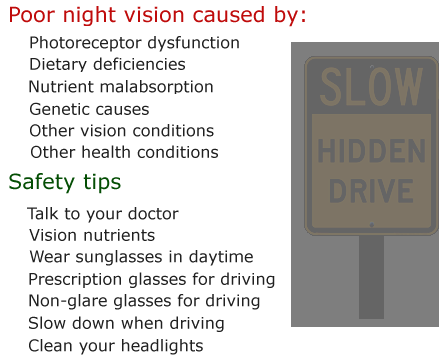
Causes & Related Conditions
Genetic causes. The rods and cones in the retina pass information via the bipolar cells and the optic nerve to the brain for interpretation. In other words, the photoreceptors are receivers of light energy, but the actual perception of vision is at the occipital cortex at the back of the brain. Genetic defects cause a breakdown in this process.
Photoreceptor dysfunction. In terms of risks and causes related to other eye disorders, retinitis pigmentosa and cone-rod dystrophy are especially associated with cone and rod problems, and therefore, night blindness.
Other vision conditions. Other conditions that may result in poor night vision include cataracts, diabetic retinopathy, effects after LASIK eye surgery, Fuch's dystrophy, keratoconus, myopia, glaucoma, macular degeneration, cone rod dystrophy, retinal detachment, and vitreous detachment.
In terms of poor night vision that occurs as a result of other diseases and conditions, this form can be progressive and potentially debilitating, depending on the cause and the success of treatment for it. However, in some cases, the problem may be reversed as the underlying condition is healed or brought under control, such as with glaucoma, cataracts, and other retinal conditions, particularly in their early stages. In later stages of these eye conditions, however, permanent damage to the photoreceptor cells may have already set in. At this point, the cells cannot be regenerated; therefore, a portion of lost vision will not be restored.
Other health conditions. Side effects of celiac disease, cystic fibrosis, bile duct obstruction, cirrhosis of the liver, Crohn’s disease, gastric bypass surgery for obesity, or cystic fibrosis can cause night blindness and/or vitamin A deficiency. Diabetes, which develops due to elevated blood-sugar levels, can also damage the retina. Poor night vision is an early indicator of damage due to diabetes, but keep in mind that this is just one of a number of eye related symptoms that can result from diabetes. Almost any progressive vision condition can result in poor vision, which tends to be especially problematic at night and also when shifting from dark-to-light or light-to-dark environments (such as when you are driving at night and another car approaches, or when stepping inside after being outside in very bright sunlight). If you are having difficulty seeing at night, in poorly lit environments, or when switching between different levels of lighting, then you should ask your doctor about your symptoms. Medications. Glaucoma medications and other eye medications may be a cause of night blindness by restricting the opening of the pupil.
Vitamin A deficiency. An early indicator of a deficiency in vitamin A may be night blindness. A primary source of vitamin A is from animal sources, so diets such as a vegan diet without eggs, dairy, fish, and/or organ meats may result in a deficiency of vitamin A, unless vegetables containing beta-carotene (sweet potato, carrots, dark leafy greens, and winter squash), which the liver and small intestines convert to vitamin A, are regularly consumed. The body makes vitamin A from beta-carotene found predominantly in yellow/orange vegetables and fruits, so if those are missing from the diet, the risk is greater. One sign of a vitamin A deficiency is the appearance of small bumps on the backs of your upper arms or legs.
Malabsorption (if it affects vitamin A absorption). Research of trace element deficiencies in night-blinded children aged 3 to 12 found that the children had low levels of zinc, copper, and iron, along with higher-than-normal levels of lead, arsenic, cadmium, and sodium.
Taurine deficiency. Taurine is essential for healthy vision, reducing the impact of oxidative stress on photoreceptors in the retina. There are several possible causes of taurine deficiency, including aging, diseases related to the liver and kidneys, heart failure, diabetes, and cancer.
Deficiency in other vitamins, minerals and amino acids, such as zinc, cysteine, and methionine can all slow the body's production of taurine. Certain diets, such as vegetarian and vegan, can lack adequate taurine. Best sources of taurine are eggs, meat, and seafood. Those who do not eat enough eggs, meat, nuts, and seeds often lack the necessary components for the production of appropriate levels of taurine, which to some extent can be produced by the body from a combination of the amino acids methionine and cysteine. Additionally, monosodium glutamate (MSG) degrades taurine.
Zinc deficiency. While zinc alone does not improve night vision, researchers have determined that its role in night vision seems especially important. Zinc is needed for the enzyme that converts retinol (vitamin A) to retinal. This latter form of vitamin A is necessary for the synthesis of rhodopsin, a protein in the eye that absorbs light and thus is involved in dark and light adaptation. If the body is deficient in zinc, vitamin A will not be utilized as efficiently, as zinc supports several aspects of vitamin A metabolism, including its absorption, transport, and utilization. Zinc seems especially important as researchers have reported that while zinc alone does not improve night vision, that if the body is deficient in zinc, then the combination of zinc and vitamin A are more effective than vitamin A.1 Zinc and protein are important to liberate vitamin A stores in the liver.
Lack of healthy fats. Since vitamin A is a fat-soluble vitamin, lack of good fats and/or bile interfere with optimal absorption. Similarly, lipid-reducing medications such as statins or those that reduce intestinal fat absorption, or foods that contain a fat replacement such as Olestra, can interfere with the absorption of vitamin A.
Poor night vision & related conditions
- Retinitis pigmentosa is associated with rod and cone problems. Patients who have a history of night blindness are directly associated with retinitis pigmentosa.9
- Rod-cone dystrophy also is specially associated with rod and cone problems.
- Other conditions that may result in poor night vision include: celiac disease, cystic fibrosis, bile duct obstruction, cirrhosis of the liver, lasik eye surgery, cataracts, diabetic retinopathy, Fuchs' dystrophy, myopia, glaucoma, macular degeneration, retinal detachment, and vitreous detachment.
- Diabetes that develops due to elevated blood sugar levels damages the retina. Night blindness is an early indicator of damage due to diabetes.
- Cataracts. Early signs of cataracts are poor night vision with halos around lights, glare and blurry vision.
- Aland Island eye disease. One of the symptoms of this genetic-caused condition is night blindness. The condition is also described as "incomplete congenital stationary night blindness."10
Night Blindness News
Want to learn more? See our blog news on poor vision at night.
Next:
Nutritional support, diet, &
lifestyle tips for night vision.
Footnotes
1. Zinc supplementation might potentiate the effect of vitamin A in restoring night vision in pregnant Nepalese women
2. The role of taurine in osmotic, mechanical, and chemical protection of the retinal rod outer segments, Petrosian AM, Haroutounian JE, Advances in Experimental Medicine & Biology 1998
6. Trace Elements & Night Blindness (2011)
7. The Biology of Taurine: Methods and Mechanisms
8. A. Canete, E. Cano, Role of Vitamin A/Retinoic Acid in Regulation of Embryonic and Adult Hematopoiesis, Nutrients, February, 2017
9. A.A. Nair, M.F. Marmore, ERG and other discriminators between advanced hydroxychloroquine retinopathy and retinitis pigmentosa,
Documenta Ophthalmologica, April, 2017.
10. M.N. Hove, K.Z. Kilic-Biyik, et al, Clinical Characteristics, Mutation Spectrum, and Prevalence of Aland Eye Disease/Incomplete Congenital Stationary Night
Blindness in Denmark, Investigations in Ophthalmology and Visual Science, December, 2016.
Also see research on night blindness.